
| Missouri Common Name | Species Common Name |
|---|---|
| Broad-banded Watersnake | Southern Watersnake |
| Bullsnake | Gophersnake |
| Central Newt | Eastern Newt |
| Eastern Coachwhip | Coachwhip |
| Eastern Spiny Softshell | Spiny Softshell |
| Midland Smooth Softshell | Smooth Softshell |
| Mississippi Mud Turtle | Eastern Mud Turtle |
| Northern Crawfish Frog | Crawfish Frog |
| Northern Red-bellied Snake | Red-bellied Snake |
| Northern Rough Greensnake | Rough Greensnake |
| Northern Scarletsnake | Scarletsnake |
| Orange-striped Ribbonsnake | Western Ribbonsnake |
| Ouachita Map Turtle | Southern Map Turtle |
| Prairie Kingsnake | Yellow-bellied Kingsnake |
| Red Milksnake | Milksnake |
| Red-eared Slider | Pond Slider |
| Southern Coal Skink | Coal Skink |
| Variable Groundsnake | Western Groundsnake |
| Western Chicken Turtle | Chicken Turtle |
| Western Cottonmouth | Cottonmouth |
| Western Lesser Siren | Lesser Siren |
| Western Mudsnake | Red-bellied Mudsnake |
| Western Painted Turtle | Painted Turtle |
| Western Pygmy Rattlesnake | Pygmy Rattlesnake |
| Western Slender Glass Lizard | Slender Glass Lizard |
| Western Smooth Earthsnake | Smooth Earthsnake |
Taxonomy and Nomenclature
Scientific and common names used in this publication follow Nicholson (2025).
We do not recognize subspecies in this project for various reasons, but have chosen to use some subspecies common names for clarity. Starting with the 2013 edition of the Atlas, we have chosen to follow the latest version of the standardized checklist published by SSAR (Nicholson 2025) as closely as possible, both as a taxonomic authority and the source for all common names. If only a single subspecies is found within the state of Missouri, we have elected to use the common name for the subspecies. If more than one subspecies is found in the state, we've chosen to use the common name for the entire species. This naming scheme follows other publications on Missouri's herpetofauna, including Briggler and Johnson (2021).
See Table 1 for a list of common names used in this project and how they differ from the names adopted by Nicholson (2025).
The reptilian order Squamata was historically split taxonomically into three suborders: lizards, snakes, and so-called worm-lizards (amphisbaenians, not found in Missouri). Upon further study, it has been proposed and widely accepted that worm-lizards and snakes arose as specialized lineages within the broader "lizard" group. This results in the former suborder Lacertilia (lizards) being "unnatural" as it implies a single lineage for all lizards that is completely separate from worm-lizards and snakes. While we apply this reality in the taxonomy for the project, the traditional "lizard" and "snake" groups are kept separate for convenience.
Species of Possible Occurrence
A number of species found in surrounding states are known to occur in close proximity to the borders of Missouri. While not currently recognized as part of the Missouri herpetofauna, some or all of these species may eventually be found within the state.
Many eastern species of amphibians and reptiles reach their westernmost documented limit at the Mississippi River, a natural and presumed geographic barrier for terrestrial animals due to its large size. Species that typically inhabit semi-aquatic or coastal and alluvial plains might be expected to be found in southeast Missouri as habitats are similar on both sides of the river.
However, Crowley's Ridge in southeast Missouri and eastern Arkansas consists of upland habitat that rises above the surrounding coastal plain. It was once continuous with the uplands on the east side of the Mississippi River. Due to a glacial meltwater flooding event in the Pleistocene, the Mississippi River changed course leaving these "eastern" uplands and their inhabitants "stranded" on the western side of the river as part of what would become the states of Missouri and Arkansas. The ridge extends from northeastern Arkansas through southeast Missouri as a series of upland "islands" and is geologically contiguous with the Benton Hills in Missouri and the Shawnee Hills in Illinois. See Figure 1 for a visual representation of this process.
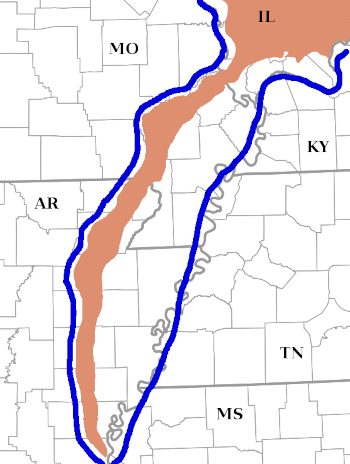
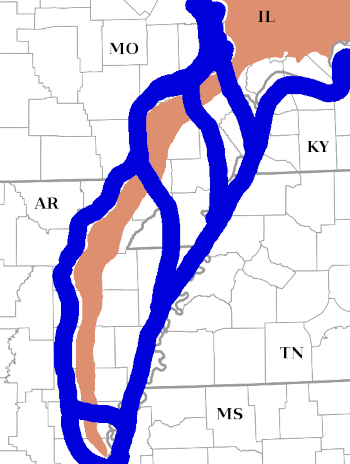
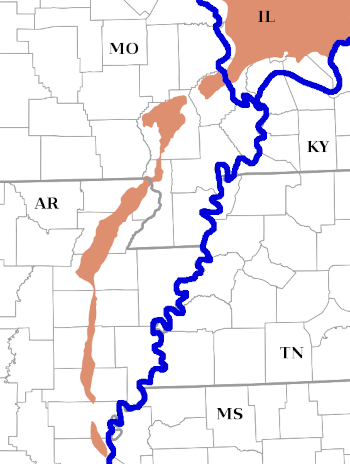
Figure 1: Formation of Crowley's Ridge in Missouri and Arkansas. Prior to the Pleistocene, the confluence of the ancestral Mississippi and Ohio Rivers was near present-day Helena AR, with a narrow but continuous spit of land separating them (top). During one or more glacial meltwater events, the ancestral Mississippi River overtopped the narrow ridge in several places, washing the ridge away and seeking a shorter path to the Gulf of Mexico (middle). During the present day, the Mississippi River flows through Thebes Gap, leaving the ancestral dividing line between the rivers as Crowley's Ridge in Arkansas and Missouri (bottom).
Due to this relatively recent event, one would expect some modern eastern species to inhabit Crowley's Ridge. Many eastern species of vascular plants are known from this area even though they are not found elsewhere in Missouri (Steyermark 1963). The Spotted Dusky Salamander (Desmognathus conanti) and Midwestern Wormsnake (Carphophis amoenus) have already been found along Crowley's Ridge in Arkansas (Trauth et al. 2004) and at least one eastern snake species, the Eastern Black Kingsnake (Lampropeltis nigra) has been documented in southeast Missouri (Edmond and Daniel 2014).
The following eastern species could potentially be found in the coastal plain or along Crowley's Ridge in southeastern Missouri.
- Spotted Dusky Salamander - Desmognathus conanti
- Southern Two-lined Salamander - Eurycea cirrigerra
- Three-lined Salamander - Eurycea guttolineata
- Northern Slimy Salamander - Plethodon glutinosus
- Northern Zigzag Salamander - Plethodon dorsalis
- Western Chorus Frog - Pseudacris triseriata
- Eastern Cricket Frog - Acris crepitans
- Bird-voiced Treefrog - Dryophytes avivoca
- Eastern Fence Lizard - Sceloporus undulatus
- Central Ratsnake - Pantherophis alleghaniensis
- Eastern Wormsnake - Carphophis amoenus
- Eastern Ribbonsnake - Thamnophis sauritus
- Eastern Box Turtle - Terrapene carolina
- American Alligator - Alligator mississippiensis
Western Missouri is a transition zone between the Eastern Temperate Forests and the Great Plains. Some species have distributions that approach Missouri's western boundary from Kansas and Oklahoma.
- Hurter's Spadefoot - Scaphiopus hurterii
- Spotted Chorus Frog - Pseudacris clarkii
- Western Milksnake - Lampropeltis gentilis
- Broad-banded Copperhead - Agkistrodon laticinctus
Erroneously Reported Species
Anderson (1945) reported two specimens of the Dwarf Salamander (Eurycea quadridigitata) from Roaring River State Park in Barry County. With the nearest known naturally occurring populations of E. quadridigitata in southern Arkansas, more than 125 miles from the Missouri border, it is likely that this record is based on misidentified, but morphologically similar Oklahoma Salamanders (E. tynerensis).
Johnson and Bader (1974) included Lesser Earless Lizard (Holbrookia maculata) based on two specimens collected from Knob Noster State Park in Johnson County. Nickerson and Krager (1972) considered this record problematic because of the close proximity of the park to Whiteman Air Force Base and Central Missouri State University. The nearest record of this species is more than 115 miles away in central Kansas. Further searches failed to produce additional specimens. As a result, this species is not considered to be part of Missouri's herpetofauna.
Anderson (1957) listed the occurrence of the Queensnake (Regina septemvittata) in Missouri based on three specimens deposited in the American Museum of Natural History collection. These specimens were ascribed to G.K. Noble and reported to come from Stone County. In further investigation by Conant (1960), Byron C. Marshall, who worked with Noble in the Interior Highlands during this period, reportedly had no recollection of finding this species. The nearest known populations of Queensnakes are in the Boston Mountains of Arkansas, approximately 80 miles south of this locality. The questions about the origin of the specimens and the absence of additional records from Missouri suggest that this species does not occur in the state.
Non-native Species
One species of non-native frog and two species of lizards have been reported in Missouri. A population of Greenhouse Frogs (Eleutherodactylus planirostris) was established inside a commercial greenhouse in Jefferson City, Missouri (J. Briggler, pers. comm.). The population of these small terrestrial breeding frogs persisted for several years, but has apparently disappeared following renovation of the greenhouse. There are no other reports of this tropical species occurring within the state. Its apparent inability to survive extreme winter weather makes it unlikely for these frogs to exist in Missouri as a free-ranging species outside of sheltered habitats, such as greenhouses.
Mediterranean Gecko (Hemidactylus turcicus) is native to the Mediterranean basin and western Asia. This species is easily transported and a highly successful colonizer. Populations of this species have been established worldwide. In the United States, this species is currently established widely throughout the south, especially along the Gulf and East Coasts. Isolated populations are also found around numerous urban centers of the Midwest and central plains (Powell et al. 2016). Two populations appear to be established in Missouri. Bufalino (2004) reported this species from Saint Louis County. A second population was discovered in Joplin, Missouri by Mr. A. Braun (Daniel et al. 2015).
Briggler et al. (2015) reported the presence of a robust population of Italian Wall Lizard (Podarcis siculus) in a Joplin neighborhood after being contacted by a resident in 2013. This population apparently descended from a series of lizards imported from Topeka KS that escaped in 2001. In many states, including Missouri, it is illegal to release non-native species. Despite prohibitions, the majority of introduced populations of this species in North America originated from released animals in the pet trade (Burke and Deichsel 2008).
Thus far, non-native amphibians and reptiles in Missouri have been confined to urban centers and do not appear to constitute a threat to our native herpetofauna. However, this is not the case everywhere and non-native species that have become invasive are considered by many biologists to be a major threat, second only to habitat loss or degradation, to native species. Responsible pet owners should always exercise care to prevent the spread of this and all non-native species into the natural environment.
Literature Cited
- 1945. New herpetological records for Missouri. Bulletin of Chicago Academy of Sciences 7(5): 271-275.
- 1957. A second list of new herpetological records for Missouri. Natural History Miscellanea (161): 1-5.
- and . 2021. The amphibians and reptiles of Missouri. (3rd ed.) Missouri Department of Conservation, Jefferson City, MO. 520p.
- , and . 2015. First record of the Northern Italian Wall Lizard (Podarcis siculus campestris) in Missouri. IRCF Reptiles and Amphibians 22(1): 43-45.
- 2004. Geographic Distribution: Hemidactylus turcicus turcicus. Herpetological Review 35: 188.
- and . 2008. Lacertid lizards introduced into North America: History and future, pp.347-353. In: J.C. Mitchell, R.E.I. Brown and B. Bartholomew (eds.) Urban Herpetology. Herpetological Conservation vol. 3. SSAR, Salt Lake City, Utah.
- 1960. The Queen Snake, Natrix septemvittata, in the Interior Highlands of Arkansas and Missouri, with comments upon similar disjunct distributions. Proceedings of The Academy of Natural Sciences of Philadelphia 112(2): 25-40.
- , and . 2015. New herpetological distribution records for Missouri in 2015. Missouri Herpetological Association Newsletter (28): 10-14.
- and . 2014. A new kingsnake for Missouri and some comments on the biogeography of southeast Missouri. Missouri Herpetological Association Newsletter (27): 18-21.
- and . 1974. Annotated checklist of Missouri amphibians and reptiles. St. Louis Herpetological Society Special Issue 1: 1-16.
- 2025. Scientific and Standard English Names of Amphibians and Reptiles of North America North of Mexico, with Comments Regarding Confidence in Our Understanding, 9th Edition. Society for the Study of Amphibians and Reptiles, Lawrence, Kansas. 87p.
- and . 1972. Additional noteworthy records of Missouri amphibians and reptiles with a possible addition to the herpetofauna. Transactions of the Kansas Academy of Science 75(3) 276-277.
- , , and . 2016. Peterson Field Guide to Reptiles and Amphibians of Eastern and Central North America. (4th ed.) Houghton Mifflin Harcourt Publishing Company, New York. 494p.
- 1963. Flora of Missouri. Iowa State University Press, Ames. 1728p.
- , , and . 2004. The Amphibians and Reptiles of Arkansas. Univ. Arkansas Press, Fayetteville. xviii + 421p.